
 By Kratiz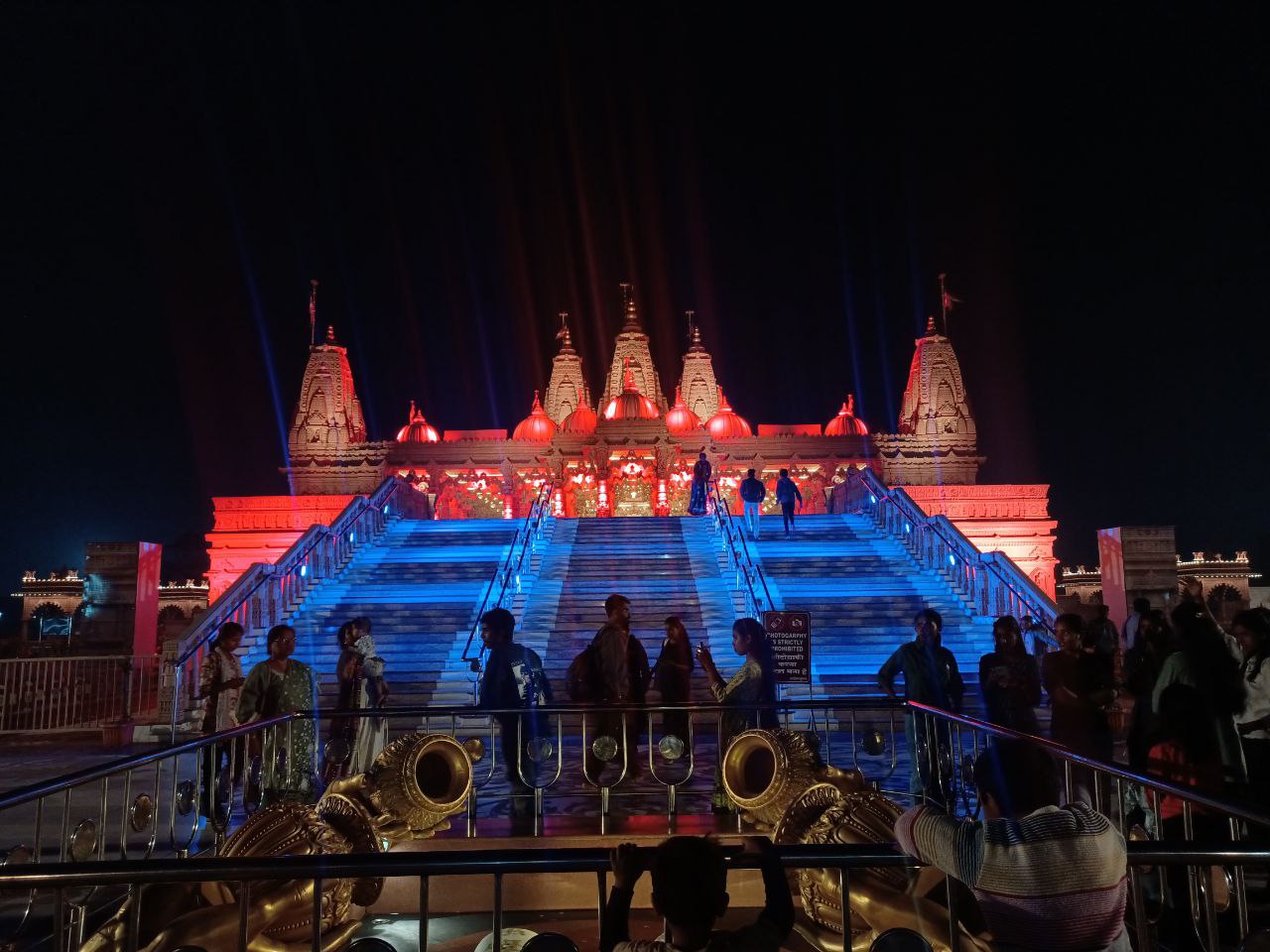
The shri Swaminarayan temple, BAPS, Nagpur
HISTORY:
The Swaminarayan, the founder of the Swaminarayan Sampraday, established temples,as part of his philosophy of theism and deity worship.
He constructed nine temples in the following cities; Ahmedabad, Bhuj, Muli, Vadtal, Junagadh, Dholera, Dholka, Gadhpur, and Jetalpur. In these temples he installed images of various Hindu gods, such as Nara-Narayana, Lakshmi Narayana, Radha Krishna, Radha Ramana, Revti-Baldevji, and Madan Mohan. Each of these nine original temples fall either under the Nar Narayan Dev Gadi, Ahmedabad or the Lakshmi Narayan Dev Gadi, Vadtal depending on their geographical location.
One of the most prominent features of the heritage of Swaminarayan Sampradaya is temple architecture. All of the temples constructed during Swaminarayan’s life show some form of Krishna, and all temples since have such murtis. In Vadtal, he consecrated his own murti known as Harikrushna Maharaj. In the temples of the dioceses of Ahmedabad and Vadtal, they are predominantly a central altar or a shrine. Human forms are predominant but for a known exception of a Hanuman temple at Sarangpur, where Hanuman is the central figure. The temples have accommodations for sadhus built next to them. Stones were quarried in far places and carried to the temple sites.
A place to visit , the environment inside the temple campus is peaceful, places where you can meditate too. just go within the timeperiod of the temple.
I went there twice and each time i feel blessed to visit such places . The architexture of the temple is beautiful, every wall , pillars of it has its own story, everywhere is the blessings only.
I feel blessed.
HISTORY OF BHAGWAN NEELKANTH VARNI later known as SWAMINARAYAN.
Biography
Childhood of Neelkanth varni as Ghanshyam
Ghanshyam Pande by his parents, Hariprasad Pande (also known as Dharmadev) and Premvati Pande (also known as Bhaktimata and Murtidevi).
Swaminarayan’s birth coincided with the Hindu festival of Rama Navami, celebrated for Lord Rama’s birth.
Swaminarayan’s followers observe both Rama Navami and Swaminarayan Jayanti on the ninth lunar day in the fortnight of the waxing moon in the month of Chaitra (March–April).
According to a legend, Swaminarayan is believed to be the earthly incarnation of Narayana from the Nara Narayana pair, cursed by sage Durvasa.
Swaminarayan had two brothers, Rampratap Pande and Ichcharam Pande. Legend has it that he mastered scriptures, including the Vedas, Upanishads, Puranas, Ramayana, and Mahabharata, by the age of seven.
Travels for Sadhna as Nilkanth Varni
After Ghanshyam Pande’s parents passed away, he left his home on June 29, 1792, when he was just 11 years old. During his travels, he took on the name Nilkanth Varni.
Nilkanth Varni journeyed extensively across India and parts of Nepal in search of a hermitage that followed what he believed was a correct understanding of Vedanta, Samkhya, Yoga, and Pancaratra. To find such a place, Nilkanth Varni asked five basic questions related to Vaishnava Vedanta:
- What is Jiva?
- What is Ishvara?
- What is Maya?
- What is Brahman?
- What is Parabrahman?
During his travels, Nilkanth Varni spent nine months mastering Astanga yoga under the guidance of an aged yogic master named Gopal Yogi.
It’s said that he visited significant temples, including the Jagannath Temple in Puri, as well as places like Badrinath, Rameswaram, Nashik, Dwarka, and Pandharpur.
In 1799, after seven years of wandering, Nilkanth’s yogi journey led him to Loj, a village in Gujarat.
There, he met Muktanand Swami, a senior disciple of Ramanand Swami, who satisfactorily answered Nilkanth’s five questions. Impressed, Nilkanth decided to stay in Loj to meet Ramanand Swami, whom he encountered a few months later.
Nilkanth later shared in the Vachnamrut that during this time, he underwent severe penance to eliminate any attachment to his family.
Leadership as Sahajanand Swami
According to the group, senior swamis of Ramanand Swami were impressed by Nilkanth’s understanding of metaphysical and epistemological concepts, along with his mental and physical discipline.
On October 20, 1800, Nilkanth Varni received sannyasa initiation from Ramanand Swami, who granted him the names Sahajanand Swami and Narayan Muni to signify his new status.
At 21 years old, Sahajanand Swami was appointed as the successor to Ramanand Swami, becoming the leader of the Uddhava Sampradaya[33] before Ramanand Swami’s passing.
The Uddhava Sampradaya was then known as the Swaminarayan Sampradaya. Sahajanand Swami advocated the worship of a single deity, Krishna or Narayana, according to sources. He considered Krishna his own ishtadevata.
In contrast to the Radha-vallabha Sampradaya in the Vaishnava sect, Sahajanand Swami took a more puritanical approach, rejecting licentious elements in Krishnology in favor of worship in the mood of majesty. This was similar to the views of earlier Vaishnava teachers, Ramanuja, and Yamunacharya.
Manifestation of God
According to the Swaminarayan tradition, Sahajanand Swami later became known as Swaminarayan after introducing a mantra at a gathering in Faneni, two weeks after Ramanand Swami’s death.
He gave his followers a new mantra, the Swaminarayan mantra, which they repeated in their rituals: Swaminarayan.
Some devotees claimed to go into a deep meditative state, called samadhi, while chanting this mantra, asserting that they could see their personal gods. Swaminarayan was also referred to as Ghanshyam Maharaj, Shreeji Maharaj, Hari Krishna Maharaj, and Shri Hari.
As early as 1804, Swaminarayan, known for reportedly performing miracles, was described as a manifestation of God in the first work written by a disciple and paramahamsa, Nishkulanand Swami.
This work, the Yama Danda, was the first literature within the Swaminarayan sect. In a meeting with Reginald Heber, the Lord Bishop of Calcutta, in 1825, Swaminarayan himself hinted that he was a manifestation of God.
Some followers believe Swaminarayan was an incarnation of Krishna, and the images and stories of Swaminarayan and Krishna align in the sect’s liturgy.
The narrative of Swaminarayan’s birth mirrors that of Krishna’s from the Bhagavata Purana scripture. Many followers consider Swaminarayan the complete manifestation of Narayana or Purushottama Narayana, surpassing other avatars.
The belief that their founder was the incarnation of the Supreme God has faced criticism. Professor Raymond B. Williams notes criticism directed at Swaminarayan for receiving significant gifts from followers, dressing and traveling like a Maharaja despite taking vows of renunciation.
In response, Swaminarayan stated that he accepted gifts for the emancipation of his followers.
Dharma
Swaminarayan encouraged his followers to live a righteous life by combining devotion and dharma. He established a global organization rooted in Gujarati traditions, using Hindu texts and rituals as its foundation. Swaminarayan was strict about maintaining gender segregation in temples.
He advocated against practices such as meat consumption, alcohol, drugs, adultery, suicide, animal sacrifices, criminal activities, and appeasement of ghosts and tantric rituals. Even for medicinal purposes, he prohibited the consumption of alcohol.
Many followers took vows before becoming disciples. According to Swaminarayan, conquering four elements—dharma, bhakti (devotion), gnana (knowledge), and vairagya (detachment)—is crucial for ultimate salvation.
Doctrinally, Swaminarayan aligned with the eleventh-century philosopher Ramanuja and disagreed with Adi Shankara’s concept of Advaita, asserting that the supreme being is not formless and that God always has a divine form.
Relations with other religions and the British Government
Swaminarayan worked to foster positive relationships with people of various religions, often meeting influential leaders. His followers came from diverse backgrounds, including Muslims and Parsis. Notably, some of his personal attendants were Khoja Muslims.
In Kathiawad, many Muslims wore necklaces given by Swaminarayan. He even met with Reginald Heber, the Lord Bishop of Calcutta and a Christian leader in India, accompanied by a significant number of disciples.
Despite a potentially tense situation with both leaders having their own guards, mutual respect developed between them.
Swaminarayan also maintained a favorable relationship with the ruling East India Company. The first temple he constructed in Ahmedabad was on land spanning 5,000 acres provided by the company government, and it received a 101-gun salute upon opening.
In an 1825 meeting with Reginald Heber, Swaminarayan hinted that he was a manifestation of Krishna. In 1830, he met with Sir John Malcolm, the Governor of Bombay, who credited Swaminarayan with bringing stability to a previously lawless region.
During this meeting, Swaminarayan presented Malcolm with a copy of the Shikshapatri, which is now housed at the Bodleian Library at the University of Oxford.
Temples and ascetics
Swaminarayan directed the building of many Hindu temples, personally overseeing the construction of six grand temples. In these temples, idols of various deities like Radha Krishna, Nara-Narayana, Laksmi Narayana, Gopinath, Radha Ramana, and Madanamohana were installed, highlighting the significance of Krishna.
Disciples of Swaminarayan composed devotional poems sung widely during festivals. Swaminarayan introduced fasting and devotion, organizing traditional folk dances like raas during festivals like Vasant Panchami, Holi, and Janmashtami.
The first temple, constructed in Ahmedabad in 1822, was on land granted by the Company Government. Responding to devotees’ requests, Swaminarayan instructed the building of temples in Bhuj, Vadtal, Dholera, Junagadh, and Gadhada, among other places.
Construction of these temples began in 1822 and continued until 1828. Before his passing, Swaminarayan also planned temples in Muli, Dholka, and Jetalpur.
Ascetics have played a vital role in the Swaminarayan sect, contributing to its growth and encouraging followers to lead virtuous lives. Tradition holds that Swaminarayan initiated 500 ascetics as paramahamsas in a single night.
Paramahamsas, esteemed spiritual teachers considered enlightened, held the highest order of sannyasi in the sect. Well-known paramahamsas included Muktanand Swami, Gopalanand Swami, Brahmanand Swami, Gunatitanand Swami, Premanand Swami, Nishkulanand Swami, and Nityanand Swami.
Ahmedabad and Vadtal Gadi
Before Swaminarayan’s passing, he made arrangements for the continuation of his spiritual lineage by establishing two leadership seats, known as gadis.
These seats were created in Ahmedabad (Nar Narayan Dev Gadi) and Vadtal (Laxmi Narayan Dev Gadi) on November 21, 1825.
Swaminarayan appointed acharyas, spiritual leaders, for each gadi to propagate his teachings and maintain the Swaminarayan Sampradaya.
These acharyas were chosen from Swaminarayan’s immediate family, specifically adopting sons from his two brothers—Ayodhyaprasad (son of elder brother Rampratap) and Raghuvira (son of younger brother Ichcharam).
Swaminarayan decreed that the acharya office should be hereditary, ensuring a direct bloodline connection from his family.
He detailed the administrative division of his followers into two territorial dioceses in a document called Desh Vibhag Lekh.
Swaminarayan instructed his devotees and saints to follow both the Acharyas and Gopalanand Swami, considered the main pillar and chief ascetic of the sampradaya. Presently, Koshalendraprasad Pande and Ajendraprasad Pande serve as acharyas of the Ahmedabad Gadi and Vadtal Gadi, respectively.
Death
In 1830, Swaminarayan told his followers that he would be leaving. On June 1, 1830, he passed away, and his followers believe that he went to Akshardham, his heavenly home, after his death. Swaminarayan was cremated following Hindu rituals at Lakshmi Wadi in Gadhada.
Just visit the place and you feel blessed and happy.
your soul will be happy.